May 15, 2019 by Klaus Crow
photo from Flickr
 Blues is one of the most important things to learn when you want to become a rock – jazz – metal – country – all round guitar player All these genres are related to or arisen from the blues. There is also a lot of blues in the songs you hear on the radio without even realizing it.
It’s hard to be a great rock n’ roll guitar player without learning the blues first. Okay maybe you can, but you will probably sound like crap. :-) Blues is what makes your guitar cry, shiver and scream. It’s got anything you need to express your feelings. Besides that there are so many cool blues songs, progressions, licks and tricks out there that will ensure you have a great time practicing and will really improve your playing a lot. So sit down, read through these essentials, get your guitar amp all cranked up, plug in your favorite blues guitar and let’s get down to serious business.
Here are the 6 essentials to master the blues. Check it out:
1. Listen
Listen to old and new blues guitar legends like Robert Johnson, Albert King, B.B. King, Buddy Guy, Stevie Ray Vaughan, Robben Ford, Eric Clapton, John Mayer, etc, etc. Listen to how they phrase. (see below). Be inspired. The more you listen to it, the more you’ll get into the blues vibe. You will hear how many different approaches there are to playing the blues, how every blues player has a unique style and way of phrasing. Listen and learn from the masters. A great way is to get a subscription to last.fm and easily find yourself a dozen brilliant blues guitar players to listen to. I can really recommend it.
2. Blues rhythm
Learn nice sounding blues chords and progressions to spice up your guitar skills.For example a 12 bar blues progression is a must to learn for every blues player. Get familiar with different blues rhythms and apply these to your progressions. A lot of guitar players nowadays underestimate the importance of playing rhythm guitar. They wanna play lead guitar right away. Don’t forget that rhythm guitar is the foundation of your playing. Don’t take it personal but without good rhythm you s@#k. There are a lot of different variations to learn so get your hands dirty and have fun with it.
3. The pentatonic scale
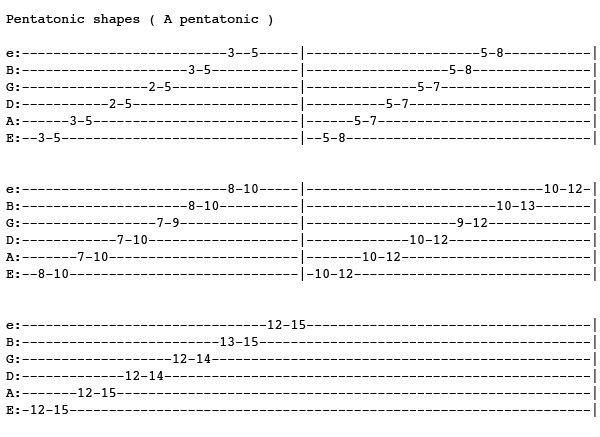
The pentatonic scale is the scale for playing lead blues and rock guitar. The scale only has five notes and is fairly easy to learn. A lot of players tend to learn only one shape and stick with that for the rest of their guitar career. While it’s good to learn the pentatonic scale in one position properly till you get the hang of it, it’s also great if you can move up the scale a little bit to create more freedom in your playing and have fun with all the different variations. So when you feel comfortable playing the blues in one position, try more shapes to challenge yourself. ( see below )
4. Licks and tricks.
Improvising is a combination of fifty percent playing things you already know (licks, triads, etc,) and fifty percent creating something on the spot (phrasing through your pentatonic scale.) So you need to learn a lot of cool blues licks to expand your guitar vocabulary. The licks you learn from books or transcribing are there to rip apart, turn around and make your own so you can use these for your improvisation. You can also use triads, arpeggios and other neat tricks to spice things up a little more. Learn to apply these licks to your improvisation.
5. Transcribe
If you really wanna get down to it you need to transcribe blues songs. Nowadays the kids learn their stuff by reading tabs from the internet and that’s okay, but there is a lot more to gain from transcribing. When you transcribe songs you learn how guitar players use phrasing and this will definitely improve your playing. Transcribing is also a good ear training practice and this is one of the keys elements to becoming a better musician. So start transcribing songs today, copy the masters note by note to learn from their skills.
6. Phrasing
Improvising is all about phrasing. When you improvise using the pentatonic scale you want your solo to sound exciting, emotional, cool and breathtaking. This is why we use phrasing. Phrasing is often being compared with speaking a language. In a language you use words to create a sentence and the sentences will tell a story. How you use those words determine how exciting the story will be. When we speak we use pauses to breath and dynamics to emphasize words and sentences. With improvising it’s the same thing. You need to pause after every couple a notes to let the music breath or it will soon get boring. You also need to use dynamics to create tension and release. And then there is rhythm, vibrato, pull-offs, hammer-ons, bending, etc. All of these tools will express the story you’re trying to tell. This is something a lot of players miss out on and it’s the most crucial thing for improvising, so dig into it. Again learn from the masters how they use phrasing.
“I’ve said that playing the blues is like having to be black twice. Stevie Ray Vaughan missed on both counts, but I never noticed.” – B.B. King

did you really put john mayer on a list of blues guitar legends?
Hi Matt,
Maybe I am ahead of things. I think he will ultimately become a guitar legend over the years. Maybe he is more a guitar hero right now, but you can argue about that too. He is already been called guitar god, hero, future legend in many guitar magazines. But that’s not the point I’m trying to make. I just want guitar players to be inspired and to learn by listening.
Anyway, thanx for pointing it out.
Klaus Crow
What about the position behind the one you’ve listed first? You can get some nice open string licks back there.
Hi Mark,
You are right about that.
The second shape/position is also the most used position in blues, because of the many possibilities. If you master this scale it’s a challenge to find a create cool licks with the other shapes as well.
Good luck with all of them!
Klaus Crow
Hi Klaus,
I have 2 questions based on what i enjoyed reading. Okay maybe a little more than 2 :)
“without good rhythm you s@#k.”
I play for a 3 piece blues band & I am having difficulty locking chords with the snare while playing lead solos.How do you play rhythm while soloing? Who do you recommend is the best artist to listen to who sound full on stage with out a rhythm guitarist?
“copy the masters note by note to learn from their skills”
I’ve listened to solos which are just 3 notes but different phrases and timing and are so beautiful to hear, but when I play along it I sounds nothing like it or i’m not feeling the connect between the phrases. How do i decode the feel and the phrasing as though they were words or sentences so i can make my own 3 not solo sound like a shiver or a cry or scream? How do i transcribe their tone & mood on paper? I want to share this idea with my band
I have a Gibson Epiphone SG series and use a Marshall tube amp i connect them through a AX 100G just for mild compression / gain & delay and of course tuning. Does the gauge of the string matter? I use 10s
Thanks for reading so far and i hope to hear from you. I love your blog and i’m going to keep coming back to keep me inspired. Thanks friend!
Cheers!
Aum
Hi Aum,
You don’t necessarily need to play rhythm and solo simultaneously. When you play live it’s okay when there is no rhythm guitar. The bass player needs to support you wherever he can.
You can also make your solo bigger by adding some extra overdrive or more reverb, chorus or delay. Great examples of bands with only one guitar player are the Red Hot Chili Peppers and The Police. Check out their live performances on youtube. Study them.
To answer your second question. It’s difficult to give advice on this because I would really need to hear you play it. The best way is to find a good teacher who can help you with details like this and give you specific instructions
The feel of a solo is something you can copy by using the right bending, vibrato, etc and by practicing it over and over while playing along. There is also a part of feel and sense of rhythm that needs to be within you. It can not be taught.
10s is definitely a good string gauge. String gauge does indeed matter. The bigger the gauge the more tone you get. Good for solos.
Good luck Aim!
Klaus Crow
Hi,
I am curious…..should lead notes on guitar be played off the snare???
Is there a blues rule for lack of a better word?
I find myself striking notes on the snare beat while improvising and do not want to create a bad habit that will be hard to break.
Thank you….I enjoyed the previous advice, very clear and to the point.
Bo
@matt (1st comment) – so im about a year and a half late on a response to the first comment regarding john mayer: i totally agree with lumping john mayer in with those other blues legends. He plays impossible licks so effortlessly and with such soul you’d think he’s been playing for 50+ years. His creativity is also second to none. Try to keep all other aspects about him and his life out of the equation and you have one of the best guitar players alive today.
Sorry Guys, I saw John Mayer once as a sincere skeptic and man was I blown away. If you can get over your disdain of pop music for one second ( a difficulty I most certainly had), you’ll realize just what an icon the guy is.
This is an awesome tab, the second position is the first scale i learned, essential for the blues. Also, John Mayer is without a doubt one of the most talented musicians alive. As far as songwriting goes, he’s superb. As for blues, hes a master. As for pop, he’s a genius.
Josh
listen to John Mayer Trio if your not fan of john mayer and you will be afterwards!
Listen to john mayer a cover of jimi hendrix’s bold as love if you don’t think that man can play the blues as well as buddy guy or another legend
U havent mentioned Joe Bonamassa as one of the guitar gods alive ( obviously cuz he’s a god. Gods never die.. ;)) and that made me upset…:/
hey matt, even eric claption said john mayer was a MASTER
https://www.youtube.com/watch?v=tzfrXiD1_Rg
Love it or hate it, John Mayer is the tourch bearer for the guitarists of this generation. He doesn’t just play the guitar, he sings through it and that’s what for me a real guitarist is.
His versatility is what stands out among the rest. If you are a true JM fan you’ll know it. The guy can play any genere at any given time.
Hey man,
I”m looking to expand my blues soloing. I know the general Blues scale and pentatonics in all the shapes. I read somewhere that nat. minor and mixoly. modes can be bluesy and that one can intertwine them with a blues scale in order to expand playing.When I tried that it didn’t sound as great as a thought it would. Just wondering if you had any advice on how I could spice things up.
Thanks
– ERiK
2019 and a bigger John Mayer fan than ever. Dude is literally still progressing.
Thank you for this blog, btw. Very helpful
Hi Anthony,
Absolutely!
Best,
Klaus Crow