Archive for the ‘Practice’ Category
20 Guitar Classics You Sure Want to Know How to Play
Photo by John W. Tuggle
Guitar players (beginners and intermediate) ask me from time to time which songs they really should know how to play on the guitar.
Sure there are a lot of songs you can mention but there are always certain songs that stand out from the rest and which most guitar players want to know how to play when they start out.
I still know how great it felt and what a victory it was when I could play “Sweet child o’ mine” and “More than words” for the first time. The golden days of learning your classics you will never forget.
To give you an idea of what guitar songs have really made a name for itself I put together a list with 20 guitar classics with help and many thanks of guitar players on twitter and in real life.
I appreciate every song you want to add to this list. I know the list is far from complete and not each and every song may suit your taste, but it’s here to give you some inspiration. You might want to learn to play some great classics that have made musical history.
Here they are:
1 Hotel California – The Eagles
2 Nothing else matters – Metallica
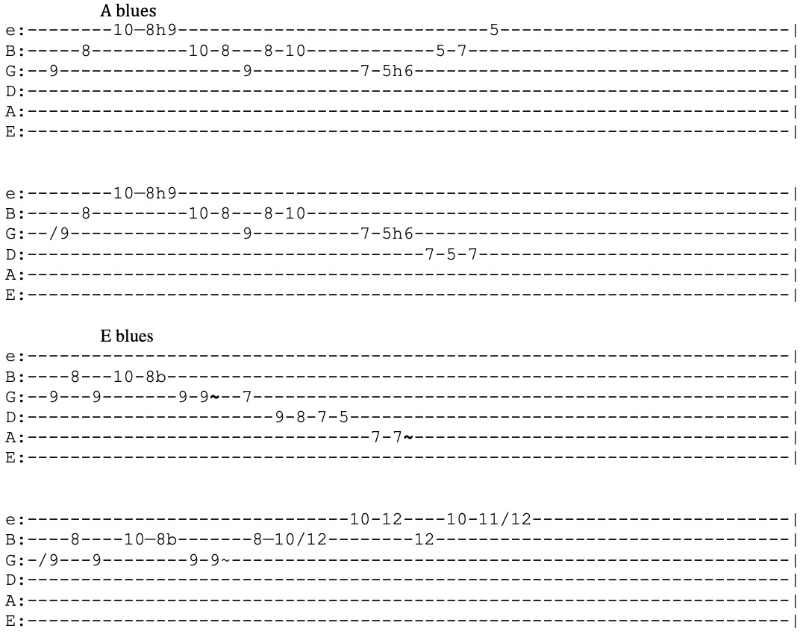
3 Juicy Blues Chord Progressions to Be Prepared
When I learned my first blues progression it wasn’t something I really got excited about.
It was okay but it didn’t make me want to play it over and over again.
I would rather prefer cool or mind blowing. Later when I started adding a sprinkle of jazz to it things became more interesting.
Blues chord progressions start to change from mediocre to superb.
So why should you learn blues chord progression in the first place?
Well first off, blues chord progressions are the foundation of blues rhythm and essential for accompanying a great blues solo.
Or you could put it the other way around, where would a great lead guitar player be without some awesome accompaniment?
This is where you come in.
So now anytime you’re in front of a lead guitar player you are cool, confident and prepared because you’ve mastered these 3 juicy blues chord progressions.
Being able to play the blues is a great tool for guitar players and musicians in general to get together, jam, explore, evolve and have a great time.
I urge you to practice these chord progressions in every key through the cycle of fourths.
Experiment with playing different rhythms, different key signatures and tempos.
It’s important to learn all 3 chord progressions by heart.
You will develop a great skill you will use the rest of your musical life.
Enjoy!
Major Blues Progression: Read the rest of this entry »
6 Cool Guitar Blues Turn Arounds in the key of E
Photo by Steve Garry
A good blues turnaround is the icing on the cake of every blues progression.
I always beg, borrow, steal and create my own nice sweet sounding turnarounds to add that extra magic when I’m playing a blues song. It’s one of the things that makes the blues sound so cool.
Blues turnarounds are played at the end of a section of a blues progression which then leads to the next section or the end of the song.
To get a good impression of how turnarounds are played listen to blues guitar players like B.B King, Albert King, Stevie Ray Vaughan and Eric Clapton and study theirs.
Tip: Every time you play the blues try to play a different turnaround, so you don’t end up playing the same turnaround ten years from now. It’s easy to fall into that trap. Expand your vocabulary!
Enjoy these 6 turnarounds to spice up your blues:
Have a great one!
Turnaround #1 e:-------0--------0--------0--------------------------------------------| B:-----------------------------0-----3--2-------------------------------| G:----4--------3--------2------1-----3--2-------------------------------| D:--6--------5--------4--------2-----2--1-------------------------------| A:---------------------------------x-3--2-------------------------------| E:----------------------------------------------------------------------|Read the rest of this entry »
22 2-String Alternate Speed Picking Exercises
Photo by Jason Rogers
A lot of cool licks used in solos are played on just 2 strings. Often on the high E and B string.
Although most common in shredding, the licks are found in all genres of music.
The best way to learn how to play these exercises clear and fluently is to practice them with the use of a metronome.
Start out slowly and gradually increase speed.
You can also use them as a warm up exercise in your daily practice workout.
Another idea is to learn to play the licks along with a backing track.
As you do this make sure you focus on correct tempo and timing.
Note: Most of the exercises below are licks, except for exercise 20 and 21.
Repetitive licks are shown by the 2 dots next to the bar line. Repeat what ever is written between those two dots. Repetitive licks are repeated at least 2 times or more.
These 22 exercises will really improve your alternate picking speed if you follow the instructions I just mentioned. You’ll have some nice chops to work with.
Have a great work out!
EXERCISE #1 (in key of D major or B minor) e:---------7--------|-----------------------------------------------------| B:--7-8-10---10-8---|-----------------------------------------------------| G:*----------------*|-----------------------------------------------------| D:*----------------*|-----------------------------------------------------| A:------------------|-----------------------------------------------------| E:------------------|-----------------------------------------------------| Read the rest of this entry »
The Ultimate Motivational Guitar Practice Workout
Photo by Robert Bejil
Practicing is the whole key to becoming a good guitar player, but a good practice workout is not just about playing songs, riffs and solos.
It consists of some important elements.
Of course like a lot of guitar players I also started out practicing songs, riffs and licks of my favorite guitar heros, it’s why I started learning guitar in the first place.
But to let your skills and creativity reach it’s full potential there is a lot more to learn.
It doesn’t matter whether you play rock, country, jazz, blues or classical guitar, practicing all the aspects below on a regular basis will motivate you and make you grow into a good skilled guitar player.
Be sure the include every aspect into your overall workout. You don’t necessarily need to put everything in one workout, but spread out over a day or week.
You’ll benefit for the rest of your guitar playing life! Read the rest of this entry »
Play The 7 Modes in 7 Days (Tabs Incl.)
Photo by Marta Monleón
Modes are used in all kinds of musical styles like Jazz, Rock, Metal, Flamenco, etc. They create a certain mood or feel to your playing.
If you feel like you are stuck playing solos using just Major/Minor or Pentatonic/Blues scales all the time, you’re ready to call on the modes and dive a little deeper.
When I first got introduced to modes I was a little bit overwhelmed, but also excited to explore this whole new world of boundless possibilities.
I soon realized it’s all about the journey and not the destination, so enjoy the process!
There are 7 modes which can be derived from the major scale:
1 – Ionian
2 – Dorian
3 – Phrygian
4 – Lydian
5 – Mixolydian
6 – Aeolian
7 – Locrian
Each mode starts and stops on a different note within the major scale.
E.g.: The Dorian mode starts on the second degree of the major scale all the way up to an octave higher, the Phrygian mode starts on the third degree of the major scale up to an octave higher, the Lydian mode starts on the fourth degree of the major scale up to an octave higher and so on.
In this post we take the C major scale to explain the modes, but you can derive the 7 modes from any major scale in any key.
For example:
C Major = C D E F G A B
C Major modes are: C Ionian, D Dorian, E Phrygian, F Lydian, G Mixolydian, A Aeolian, B Locrian.
G Major = G A B C D E F#
G Major modes are: G Ionian, A Dorian, B Phrygian, C Lydian, D Mixolydian, E Aeolian, F# Locrian. Read the rest of this entry »