May 15, 2019 by Klaus Crow
Photo by Simone13 AKA John Pastorello
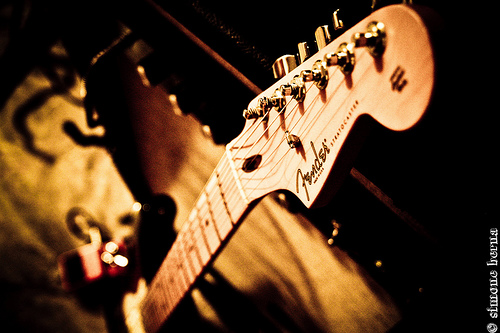 Besides writing and playing songs I just love improvising.
When I practice improvising I always first pour myself a cup of green tea, I put on some folk music (e.g. Ray La Montagne, Damien Rice, Stephen Fretwell, Glen Hansard, Sheryl Crow, etc.) on Last.fm or Spotify and then I start to improvise over these songs. I get totally caught up in the moment and let my fingers carry me away.
Other times I practice melodic patterns, triads, arpeggios, licks, everything that will spice up my improvisation skills. You can never stop growing. There is always more to learn and explore.
Improvising is one of the most fun and fulfilling aspects of guitar playing, but also something that requires a lot of hard work and dedication. It’s the next step in becoming a better guitar player.
Here are 10 basic essentials that will help you become a better improviser.
1 – Pentatonics / blues
Learn to play the pentatonic/blues scale all over the neck in all five shapes. It will take some time to learn this thoroughly, but if you practice regularly it will really pay off. The pentatonic / blues scale is the corner stone of all soloing in blues, pop, country, rock and metal. Learn not only the scale, but also how to use it for improvisation. See below.
2 – Major Scale
Next to the pentatonic scale, the major scale is the most important scale to learn.
Learn to play the major scale all over the neck in every position starting from the root note. Again this takes time, but learn thoroughly. It is worth the effort.
Once you can play the scale in all positions, connect the different shapes/positions with each other. For example: Play one part of the scale in the first position, continue the scale in the second position and then go on to the third position. Experiment and try different combinations.
The most exciting and challenging part is learning how to improvise with the scales. That is what you are heading for.
3- Melodic patterns
Melodic patterns or sequences will help you not to sound like you are playing scales all the time. It will expand your possibilities and create more freedom in your playing. They are really useful when improvising. Learn to play the scales in 3rds, 4ths, 5ths, 6ths, 3 in a line, 4 in a line, etc.
Example:
Major scale = 1 2 3 4 5 6 7 8 9 10 11 12 13 14 15
C major scale = C D E F G A B C D E F G A B C
3rds = 1 3, 2 4, 3 5, 4 6, 5 7, 6 8, 7 9, 8 10, 9 11, etc.
C major scale = C E, D F, E G, F A, G B, A C, B D, C E, D F, etc.
4ths = 1 4, 2 5, 3 6, 4 7, 5 8, 6 9, 7 10, 8 11, 9 12, etc.
5ths = 1 5, 2 6, 3 7, 4 8, 5 9, 6 10, 7 11, 8 12, 9 13, etc.
6ths = 1 6, 2 7, 3 8, 4 9, 5 10, 6 11, 7 12, 8 13, 9 14, etc.
3 in a line = 123, 234, 345, 456, 567, 678, 789, etc.
4 in a line = 1234, 2345, 3456, 4567, 5678, 6789, etc.
4 – Random notes
Practice playing random notes through the scale. For example:
Major scale = 1 2 3 4 5 6 7 8 9 10 11 12 13 14 15
Pick out notes randomly: 1 6 3 2 12 15 3 5 11 7 etc.
This will help you to learn the scale thoroughly, it will make you more flexible and again give you more freedom when improvising.
5 – Triads
Triads are used to open up your playing and get away from playing diatonic and pentatonic scale runs. Triads are 3 note chords. You can play a triad starting from the first/root note (the root position triad), from the second note (the 1st inversion) and from the 3rd note (2nd inversion). There are 4 different types of triads : major, minor, augmented and diminished. A major triad is formed by the 1st, 3rd and 5th note of the major scale.
Example:
Major scale = 1 2 3 4 5 6 7 8, Cmajor scale = C D E F G A B C
Major triad = 1 3 5, Cmajor triad = C E G (= C)
Minor triad = 1 b3 5, Cminor triad = C Eb G (= Cm)
Augmented triad = 1 3 #5, Caug triad = C E G# (= C+)
Diminished triad = 1 b3 b5, Cdim triad = C Eb Gb (= Co)
Learn all the triads you can play through a major scale. For example:
C major scale: Cmajor triad, Dmin triad, Emin triad, Fmajor triad, Gmajor triad, Amin triad and Bdim triad. You can use all these triads improvising through a Cmajor scale, A minor scale or A minor pentatonic.
6 – Arppegios
Learn arpeggios and incorporate them in your playing. Arpeggios are like triads, they are used to open up your playing and create more color and variety to your improvisation. A triad is actually an arpeggio if it is played note by note, ascending or descending. While a triad contains only three notes, an arpeggio can be expanded with a b7, maj7, a 9th, 11th, etc which gives you endless possibilities.
7 – Licks
A lick is a short series of notes that creates a cool melodic line which can be used in your improvisation. Increase your lick vocabulary. Learning new licks is an ongoing process that will keep your improvisation sound fresh and help you grow becoming a better player.
8 – Modes
Learn to play all the 7 modes of the major scale to expand your improvising skills even more. The 7 modes are:
– Ionian = 1 2 3 4 5 6 7 8
– Dorian = 1 2 b3 4 5 6 b7 8
– Phrygian = 1 b2 b3 4 5 b6 b7 8
– Lydian = 1 2 3 #4 5 6 7 8
– Mixolydian = 1 2 3 4 5 6 b7 8
– Aeolian = 1 2 b3 4 5 b6 b7 8
– Locrian = 1 b2 b3 4 b5 b6 b7 8
9 – Solos
Transcribe and learn solos from the greatest guitar players to be inspired. Steal, copy their licks and make your own out of them. Study how they phrase and use rhythm in their soloing. Learn solos in different styles and genres; Blues, rock, country, metal, pop, etc. There is much to be learned from different guitar players.
10 – Improvise
The best way to learn how to improvise is actually do it.
Put on your favorite songs or use a backing track and start improvising over the chord progressions. Play licks. melodic patterns, triads, arpeggios, every thing you learned, then combine, improvise, phrase, experiment, make mistakes, try again, put your soul into it and let your fingers lead the way.
Regardless of what you play, the biggest thing is keeping the feel going. – Wes Montgomery
Leave a comment anytime you want.

i like ur tutorials very much. it’s been of great help. i’m learning to play the guitar(acoustic so far) very passionately on my own for the last year and a half. i’ve saved this page for future referrals. thanks for this very helpful article!
Hi Junil,
Happy to hear I could help you out.
If you need more help let me know.
Thanx for the comment.
Klaus Crow
Good advices! I’d like to add: try to imitate the melody of the singer (if present) with all it’s little detunes and phrasing. That will make your improvisation much more vivid and unique and will improve your ability to play emotional lines!
Hi Pewehh,
That’s a great tip! I second that.
I once heard a story about bass player Jaco Pastorius. He tried to play along the vocal melody of every song he heard on the radio or TV for hours and hours.
That’s how you become awesome!
Klaus Crow
Hi Klaus
I’m sorry but I am no longer able to hold my guitar where it should be held. (I’ve lost the key to the case) and besides it took me over 50 years to learn the intro to Johnny B Goode. What fingers do you play pentatonics with? I’ve been trying for so long now but my children always tell me to take off my gloves first, but it’s so cold out here at the bottom of my garden where every one tells me where to go and practice. I play all the right notes but in the wrong order. Your numbering seems a bit confusing. I tried loading it up in my Jam man but then I forgot to tread on it. I think that you don’t need to practice scales as such you need to remember where to put your fingers. That is after you’ve taken off your boxing gloves.
Well, I must practice again or my teacher (Andres) will smack me. He can’t Segovia much nowadays.
You asked for comments so I thought I’d join in, but I can’t think of anything sensible to say after you’ve said it all!!!
Thanks for your Guitar Habits
Jim (Eugene Crudd)
Hi Jim,
Maybe you would like to check out my post “The 5 Pentatonic Scale Shapes You Must Know”. http://bit.ly/cjmPQJ
Here you can see how and where to put your fingers on the strings.
I hope your family will be a little more considerate in the future concerning your guitar ambitions.
Thanks for taking the time to comment. :)
Good luck to you Jim!
Hi Klaus,
I stumbled upon your link at the most crucial part of my life where I need to make a pact with myself that i practice everyday for at least 2 hours. And these essentials is just what i wished for to get me started. I do jam with my bands at least 2wice a week,but i feel that practicing as a group is not the same as practicing alone. I am trying to convince the rest of the band to get into the individual practice routine they don’t listen. How do professional bands do it?
Thanks again,
Aum (India)
Hi Aim,
Professionals also practice with their band as well as on their own.
You’ve guessed it right. Practicing on your own is a totally different thing.
Here is where you can totally focus in detail on your technical skills, theory knowledge, improving your improvisation, etc.
Do it both.
Klaus Crow
Hey, I love the article, it’s a great tutorial. I think it would help to explain that the pentatonic scale is the same as the major scale except it leaves out two notes. So when people are trying to learn the major scale, they won’t feel like they’re trying to learn a whole new series of notes and can instead relate to the pentatonic scale to understand where the other notes lie on the fretboard. Also, I think you should mention that modes are simply playing the major scale (i.e. same spacing of notes) except you start and end on a note other than the root. I know these things are somewhat basic, but if people don’t know them then it can make learning how to play seem a lot more difficult. Just thought I’d put in my two cents.
Hi Kevin,
There is a lot more to tell about every topic.
I didn’t want to go into too much detail otherwise it would be a very very long post.
I rather save the details for another post, but thanks anyway for adding your two cents.
It’s good advice. I appreciate it.
Klaus
I truly wanted to write down a brief note so as to say thanks to you for the splendid ways you are giving out on this site. My extended internet look up has finally been rewarded with professional details to write about with my family members. I would admit that most of us site visitors are undoubtedly endowed to dwell in a superb network with very many wonderful people with insightful tips. I feel somewhat grateful to have come across your web site and look forward to really more thrilling minutes reading here. Thanks once more for everything.
after using your tutes to practice, I offer up my efforts.
http://www.akaname.net
enjoy… or not :/
In school I recieved 6 in song. (Music). Nobody recieved any worse. So I gave it up.
When about 30 yars old I built a 4 string “guitar” with strings of plastic line.. Then I dared buy a *real* guitar with steelstrings and later my still favorite guitar with nylonstrings.
All acustical.
I *have* played guitar more or less classical style. I really liked to pick russian tunes, old and new in fingerstyle. However the russian music often asks for less thin sounds than you can get from a semiclassic ” guitar.
On a visit to a russian speaking country I bought a simple but beautiful sounding Bayan which I imagine seems to love the russian tunes. I have been training Bayan for about 6 years starting at the age of 70. Not so terribly young isn’t it.
My present teacher has recommended that I somehow should learn to play music without depending on notesheets.
Although my instrument presently is mainly Bayan with some interspersed guitar and harmonica I belive that playing by ear and improvising is mostly similiar whatever instrument you play.
I shall certainly read what I found on your site and try to assimilate it.
Perhaps you would be interested to write something about how to connect the tune you hear and alternatively the tune you hear in your head to performance on guitar or whatever.
Anyways I’ll read your texts and it seems as if there were valuable hints in them
Thanks
Signature “Chuck the Monk”
This is great content. You’ve loaded this with useful, informative content that any reader can understand. I enjoy reading articles that are so very well-written.
great post…thanks for share this tips..keep up
I appreciate well-written and informative content. This article shows the writer’s knowledge of the subject matter as well as masterful writing skills. I enjoyed this article and will return for more very soon. Thank you.
Very good site,and great teaching.You make it easy to understand.
When I originally commented I clicked the -Notify me when new comments are added- checkbox and now each time a comment is added I get four emails with the same comment. Is there any way you can remove me from that service? Thanks!
Hiya! Quick question that’s totally off topic. Do you know how to make your site mobile friendly? My blog looks weird when browsing from my apple iphone. I’m trying to find a theme or plugin that might be able to correct this issue. If you have any suggestions, please share. Thank you!
Hi Odchudzanie,
Each time you get a notifying email for new comments there’s an unsubsribe section at the bottom of the email. Check or uncheck the box (depending on the question) and submit.
Best regards,
Klaus Crow
Hey Klaus
Thank you for this great post. It is inspiring i can say. I really enjoyed reading it. Thanx
Hi! Would you mind if I share your blog with my myspace group? There’s a lot of people that I think would really enjoy your content. Please let me know. Thank you
Hai Shaneka,
Be my guest.
Best regards,
Klaus
Hi Klaus, thank you for this great blog! It’s a veritable goldmine of information!
Great, thanks for sharing this blog post great blog,
Let me share with you a nice video http://www.youtube.com/watch?v=6QcT17lqIiI
Hey there, i dont get it with the modes, if you learn you majorscale in all positions u basically know all the modes already
Pls I want to ask that which of the strings when improvising is the most appropriate to take ones root note from,,is it the second or the third string because some lick are easier to copy when you pick your root note from the third string and vice-versa…thanks
Oh ey! Its nice to get these articles,
Well everything I’ve been learning on guitar keeps my interest in it growing, but I’ve not been playing outside, I pactice alone and what remains for me to learn Ȋ̝̊̅§ the modes and experience on how to solo, I really suck most of the time trying to solo, well I use to think it to be that I have not yet played on electric guitar, cos everything I’ve learnd , I have played on accoustic, so most times -ts not eazy bending noted, hammer-ons and most especially, finger tapin….
Very cool
Hi klaus, am just indebted to comment that you have said it all,coincise,precise and extremely article right there!!!!!
There is a old Japansese Haiku that says, “Snail Snail. Climb Mt. Fuji. Slowly Slowly.
Thanks for your words on Tao and Zen and your words on the Fretboard. The information which is on the Ten Essentials, is challenging. When you talk about melogics and triads it goes beyond me and I don’t know how to use it. I think thta if there were further explanation on these area it might help. I will read it a few more times to see if I can apply it.
I think you owulld appreciate it, at least from my point of view.
Keep up the good work. The fretboard entry is well worth doing. Perhaps I will prgress enought to make use of the rest.
Patience is the key
Hi!
Just 2 questions.
What should a daily 30 min warm up session for a guitar include?
Is it really a good idea to learn sweep picking when you’re done with the modes and scales?
Thanks.
relly great site and helped me out immensely
Yes. Everyone, that point about pentatonics, someone said it, a pentatonic scale with just 2 notes added becomes a major scale. So learn the pentatonics well, then add in that missing 4th note and that missing 7th note and you have the major scale. They also said the other fundamentally important thing, about modes, that the major scale and the mode scales are the same scale, just start on any chosen note and finish an octave higher. So in C scale you might choose to start on D and play DEFGABCD or start on F and play FGABCDEF. D to D is the 2nd mode, F to F is the 4th mode. To really hear it working play the mode against it’s chord, so the chords for the key of C are C, Dm, Em, F, G7, Am, Bm7 flat5. So to hear that 2nd mode for example play the Dm chord while playing the scale DEFGABCD. To hear the 4th mode for example play the F chord and play the scale FGABCDEF. Same for any mode you choose, same principle for any key you choose. Staying in the mode is a great way to explore improvisation. Do not underestimate the value of this, it is the best simple thing i have discovered. Try it with a friend. The possibilities are limitless. I’d call it modal soloing on a modal chord, because that is what it is. Hear the character of each mode, make infinite melodies of any chosen flavour.
Thanks for sharing.
Learn a lot from this great article.
thanks man this is really very helpful. I’ve been going around simply playing the scales back and forth and have heard about it helping in the formation of chords and improvising and stuffs bt the articles that i’ve read dont actually teach you how to do so…..the examples are really helpful!!! This has really helped me…..looking forward for some more tips so that i can make my guitar playing experience even better!
When you play the modal scale against its chord, you’ll find the sweetest note will be the root note of the chord. Then every second note, will be sweet too. Example: play C chord, the sweetest notes of the scale CDEFGABC (against the C chord) will be CEGB, [every second note from the root note C]. Another example: play Dm chord, the sweetest notes of the scale CDEFGABC (when played against the Dm chord) will be DFAC, [every second note from the chord’s root note D]. Same, for Em chord the root note E is the sweetest, EGBD are all quite sweet. Same for F chord, sweet with FACE. For G, sweet with GBDF. Am, sweet with ACEG. The 7th chord is Bm7flat5 also called B half diminished, it is sweet with BDFA.
In fact the sweet notes in each instance ARE the chord, that is what a chord is (in a perfectly harmonised musical world / while note substitutions might create ‘less perfectly’ harmonised chords, such as sus2’s and sus4’s etc). So it is pretty obvious the notes of the scale, create all the chords of the key, in their respective combinations. When improvising play any of the scale notes, hear them against the chord to hear the mode, hear their sweet notes occuring at every 2nd note, know that the root note of your chosen chord is the core note of your mode and therefore is the sweetest note in its mode.
Chords can be extended. Two note ‘chords’ become more like a true chord when they get an additional note to become a triad. 4 note chords become maj7ths or minor 7ths, (add another note, you are into the next octave), to get a fully fleshed out 9th chord, same applies when building 11th’s and flat13th’s, etc, though it becomes practical to omit obvious notes wuch as 5ths (which somebody else will probably be playing anyway).
Great article, I’d like to add this link if I may: unlockthefretboard it’s a great book on guitar improvisation I’ve been working out of and definitely goes well with your master list! Cheers!
Dude. I was just about to say `You didn’t mention Pat`
But then I saw you quoted Wes Montgomery.
Well played, Crow, well played.
This is such an amazing website. It has a lot of practical knowledge. I really need to change the way I think. I have to realize that there are no good or bad practice sessions. Everything is a learning experience!
Hey
Thanks for the good habits. I really appreciate it. It been almost 16 yrs I played guitar still there so many thing to learn. Though I didn’t took classes for guitar these things really help me..
Really appreciate u man..
May I recommend learning the Major scale first then the three forms of the minor scale, before focusing on Pentatonic. The major and minor scales are by far the most used scales of the past three hundred years and practicing them will lead to an understanding of keys. Fluency with keys and understanding there relationships to each other will make you the most affective musician in the room.
Also, knowing all three triad inversions and hearing the difference between each will add depth and color to your playing.
Practice with a metronome.
Practice hymns. These will get you playing in the flat keys that you may not be used to. Plus people love hymns.
A great article and on the topic which requires most effort, work and understanding. Thanks for sharing :)
Hi, This information is exactly what I’m looking for. I learned the pentatonic scale and can’t seem to do anything with it.
Hi, great article. I’ve been playing solos for a while myself and I can tell this is some usefull stuff.
Still modes is something that I find super confusing. I almost never pay attention to them and it seems absolutely ok. Is it necessary to learn all the difficult modes to get better at improv?
Thanks.